
 Winternitz One-Time Signature (WOTS)
The Winternitz One-Time Signature (WOTS) was proposed by Winternitz in 1979, shortly before the publication of Lamport's paper. It is described by Merkle [MER79].
Winternitz improvement (WOTS)
Winternitz parameter
A problem with Winternitz
Adding a checksum to WOTS
WOTS+
Winternitz improvement (WOTS)
-
Have a secret key $x$ and apply $H$ repeatedly $w$ times to form the public key, for example $pk = H^{w}(x)$ where $w=16$.
- where $H^w = H(H(H(\cdots(H(x))))$ denotes $H$ applied $w$ times. We call this a hash chain.
- This allows us to sign $\log_2(16) = 4$ bits of information instead of just one with a single key value.
- To create a signature, split the message digest to be signed into blocks of 4 bits and interpret each block of 4 bits as an integer in the range $[0,15]$.
- To sign the 4 bit message $1001$ (decimal 9), reveal $H^9(x)$.
- To verify, compute $H^7(H^9(x)) = H^{16}(x)$ and check this equals the published value of $H^{16}(x)$.
- More generally, given a message integer $m$ in the range $[0,w-1]$, reveal $H^{m}(x)$ as its signature.
- To verify, show that $H^{w-m}(H^{m}(x)) = H^w(x)$.
So, to use a naive Winternitz OTS scheme using SHA-256 with $w=16$, we do the following
- Your private key is $x_0, x_1, x_2, \ldots, x_{63}$
- Your public key is $H^{16}(x_0), H^{16}(x_1), H^{16}(x_2), \ldots, H^{16}(x_{63})$
- Compute a 256-bit digest of the message $M$ to-be-signed, $md = \text{SHA-256}(M)$.
- Split the 256-bit $md$ into 64 four-bit blocks and interpret each block as an index integer $m_i$ in the range $[0,15]$
- $md = m_0, m_1, \ldots m_i, \ldots m_{63}$; $0 \leq m_i < 16$
- For each $m_i$, reveal $H^{m_i}(x)$ as its signature
An example with $w = 16$ and a message digest of 256 bits.
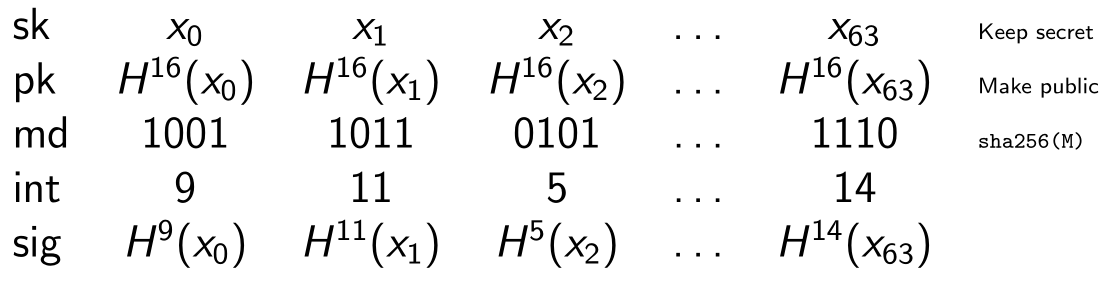
Winternitz parameter
- The value of $w$ is called the Winternitz parameter.
- We don't have to use $w=16$, we can use other convenient powers of two such as 4 or 256.
- $w$ is usually selected from the set $\{4,16,256\}$ giving convenient bit lengths of $\log_2(w)$ $\{2,4,8\}$, respectively.
- be aware that some authors use $w$ to denote the number of bits, so the range of integers becomes $[0, 2^w-1]$.
- Choosing a value for $w$ is a trade off between a shorter signature and increased processing time. Its value has no effect on the security of the scheme.
A problem with Winternitz
- Since $F^9(x)$ is public, an attacker could compute $F^{10}(x)$ and claim that the signed 4-bit message was 1010 (decimal 10) rather than 1001.
- More generally, if an attacker can find a message digest where each index value is greater than the original, they can forge a signature over the new message.
- To fix, we append a checksum to the message digest before signing.
- If the digest has length $n$, the checksum is typically of length of the order $\log_2(n)$.
Adding a checksum to WOTS
Here is a way to compute a checksum, as used in SLH-DSA. For our example above, len_1 = 64 and the length of the checksum is 12 bits.
// Compute checksum for msg of len_1 w-bit integers
csum = 0;
for ( i = 0; i < len_1; i++ ) {
   csum = csum + w - 1 - msg[i];
}
- The checksum is converted to a bit string of length 12 bits, split into 3 x 4-bit blocks to give 3 more index integers, which are appended to the 64 integers from the message digest.
- The signature is now computed over these 67 integers instead of 64. Note that we now need a key of 67 values.
- Remember that a forgery is only possible if we can find a new message digest with every index value greater than the original.
- The checksum computed here ensures that if such a message digest exists, then the checksum will produce at least one index less than the original, which cannot be forged.
- We will see an example of this later when we compute the The Hyper Tree Signature.
WOTS+
WOTS+ is an improvement over WOTS designed to prevent certain attacks. [WOTSPLUS]
The idea is that instead of just using the plain hash function $H$ each time in the hash chain, a different chaining function is used every time derived from a "family" of keyed hash functions. By family of hash functions it means use a keyed hash function with a "tweak". This ensures domain separation between each member of the hash function family.
A tweakable hash function takes public parameters P and context information in form of a tweak T in addition to the message input. The public parameters can be thought of as a function key or index. The tweak can be interpreted as a nonce.
F = H(PUBLICKEY || NONCE || msg[i])
In practice, this just means that the input to the hash function is distinct each time it is called.
In SLH-DSA, the function F is defined as
F(PK.seed, ADRS, X) = Hash(PK.seed || ADRS || X)where
PK.seed is a public seed, ADRS is an address in the virtual tree structure of SLH-DSA, and X is the input string.
In plain WOTS, where $pk=H^w(x)$, we can define a chaining function $C$ recursively as
C[i] = H(C[i-1]), C[0] = X
so $C[w] = H^w(x)$. This uses the same H function for each iteration.
In WOTS+, the chaining function $C$ is defined recursively using the tweakable hash function $F$
C[i] = F(PK.seed, ADRS[i], C[i-1]), C[0] = X
where ADRS[i] includes the counter, $i$.
Domain separation is used to allow the use of the same hash function in different situations (domains). By adding a domain separator that is different each time
(PK.seed||ADRS[i]) you are effectively using a different hash function each time you hash msg which ensures a different result even if msg[i] repeats.
Chinese translation
Zhanglu Wang has kindly translated this page to Chinese on the CSDN site Winternitz 一次性签名 (WOTS). Thank you Wang.
Rate this page
Contact us
To comment on this page or to contact us, please send us a message.
This page first published 17 March 2023. Last updated 30 August 2026.

